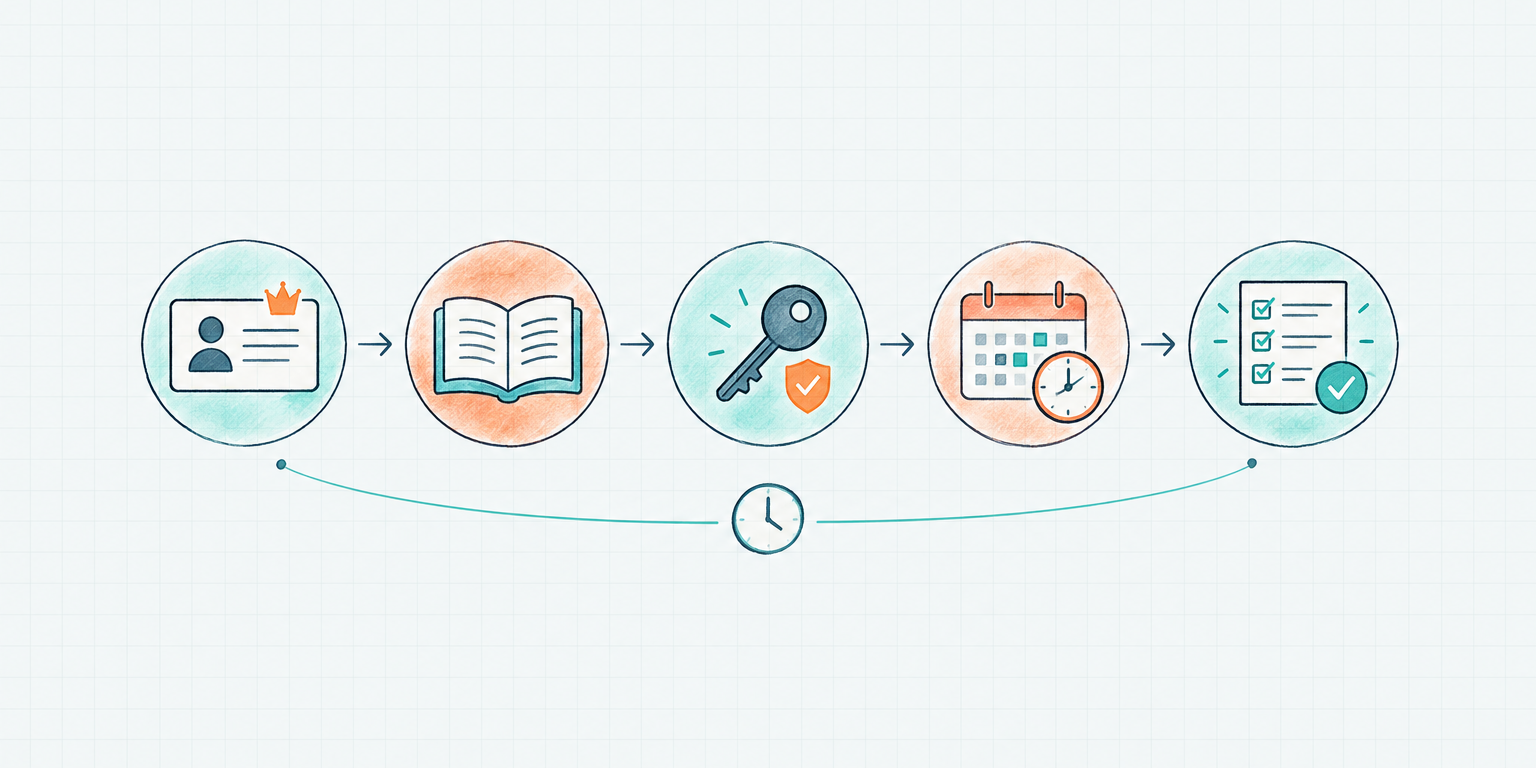
A new hire who spends week one waiting for access is expensive. An autonomous agent that spends week one waiting for a prompt is the same problem, compressed.
Onboarding AI agents is a context transfer. In 30 minutes you can give an agent a role, a handbook, its own accounts, one recurring job, and a first deliverable someone can inspect. The half hour does not teach the company. It gives the agent a place to start learning it.
Harvard Business School's Joseph Fuller put this in operating terms in March 2026: treat agents less like new technology and more like employees, with defined roles, clear boundaries, explicit accountability, and regular evaluation. The first half hour is where those conditions get set.
What "done" looks like at minute 30
The agent should be able to:
- Name its role and the first job it owns
- Point to the company, product, and audience it serves
- Name who it reports to and when it must ask
- Use its own identity in the tools it needs
- Have one scheduled or event-driven responsibility on the calendar
- Be working on a first visible deliverable
If any of those are missing, the agent can still answer questions. It cannot own the seat.
Minutes 0-5: Hire the role
Open Hire or go to /agents/discover. Pick the pre-built agent that matches the work. If none matches, use the Generalist Agent.
Give it a name. Keep the recommended role and department unless you have a reason to change them. Choose a voice and a face that fit the persona. The default computer works for most jobs. Windows is for Windows-specific environments or social-media work. A dedicated Mac is only needed when the work has to happen on a machine in a specific place.
Select Next and continue while the computer sets up. You do not need to stare at a progress bar.
This step is fast because you are not running an interview loop. You are putting a capable agent into a seat and giving it the context the seat requires.
Minutes 5-12: Write the job on one page
Start a thread. Send a short greeting. The agent will introduce itself and ask for what it needs.
Answer with the same briefing you would give a human teammate on day one. Octavus's onboarding guide is explicit about this:
- Company and product, including the customers or audience to keep in mind
- Role, expectations, and immediate focus
- Who the agent works with and how decisions get made
Write the job so a stranger could execute it. Include what the agent is responsible for, where its authority stops, when it must ask a named person, and what the first deliverable looks like. HBR's onboarding frame maps to how managers already hire people: a job description with limits and a path to human input.
Do not dump a 4,000-word prompt into the first message. A one-page operating brief beats a novel the agent cannot retrieve later.
Minutes 12-18: Point it at a handbook
If the process lives only in someone's head, the agent will escalate at the first ambiguous decision.
Give it five pages, or write them now if they do not exist:
- Responsibilities
- Workflow
- Decision rules
- Escalation path
- Definition of done
A handbook is an AI agent knowledge base: searchable, versioned, and owned. GitLab started its public handbook at ten people so company information would remain accessible no matter when someone joined. Agents need the same thing for the same reason.
Keep today's campaign status out of the handbook. Put durable rules there. Put work-in-progress with the work. Octavus describes the Handbook as a shared reference for how an organization operates. Over time it can become the source code for that operating knowledge.
Minutes 18-24: Give it its own keys
Review the access the agent requests: company email, Slack or Teams, CRM, calendar. Grant it through the organization's approved process. Do not paste a real password into a thread.
Treat the agent like a human teammate:
- Choose this specific agent.
- Grant its own work identity the minimum access you are comfortable with.
- Ask the agent to connect the service using that identity.
The external system still enforces its own permissions. Shared logins erase accountability. Least privilege reduces the blast radius of a bad first day.
Once email or Slack is connected, you can keep working with the agent there. The thread remains the record.
Minutes 24-28: Assign one recurring job and one first deliverable
A role without a calendar still waits for someone to type.
Ask the agent to put one recurring responsibility on its own calendar. Write the scheduled prompt as an operating brief: trigger, inputs, what done looks like, when to stop. A vague reminder creates a 7am clarifying question.
Then give it one first deliverable that someone can inspect today. Not "help with marketing." "Map the current Salesforce and Marketo process and write down how it actually works." CodeSignal used that pattern after a marketing-ops seat opened: the agent mapped the systems in a day and had process fixes and campaigns moving by day two. Collectly put a recruiter agent on a VP of Sales search and had candidate pipeline moving by day two.
The first deliverable proves the onboarding worked. The calendar keeps the role alive after you close the tab.
See event-driven AI agents for how schedules and events should start work after Day 1.
Minutes 28-30: Set the review loop
Tell the agent who owns quality, what it may decide alone, what it must escalate, and where to put the result.
Open the first Thread when you need the outcome, the reasoning, or a correction. Most work should happen in the background. If you have to watch every minute, the job is not ready to run unattended.
Memory will be thin on Day 1. That is expected. Short-term memory holds the current work. Durable facts should land in long-term memory. Detailed research belongs in notes. The agent can maintain this as it works; you can inspect it. AI agent memory is how the second week does not start from zero.
A 30-minute onboarding checklist
Before you leave the first session, confirm:
- Role - A named seat with a bounded first job
- Context - Company, product, audience, and management structure
- Handbook - Five durable pages the agent can search
- Identity - Its own accounts and least-privilege access
- Cadence - One scheduled or event-driven responsibility
- Deliverable - One visible output due today
- Escalation - Named owner, stop conditions, and a thread to review
Skip any item and you will spend the next week repeating yourself.
Getting Started
Hire a pre-built Octavus Agent. Follow the hire and onboard guides. Put the first job on the schedule. Review the run in Threads.
Then leave the chat.
Give an autonomous teammate a role, a handbook, its own access, and a first job it can finish without waiting for another prompt.