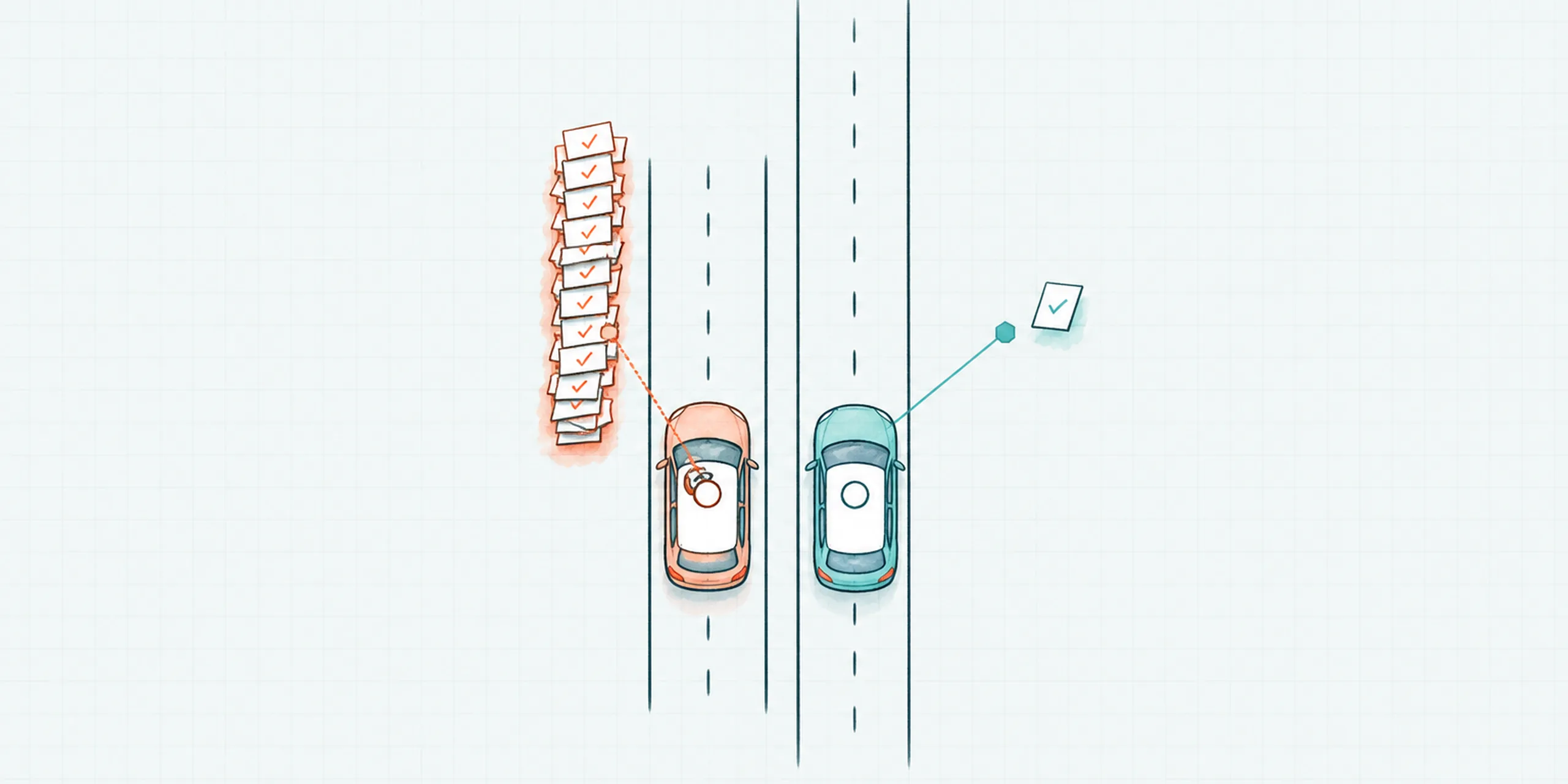
Two cars leave the same airport for the same hotel. In the first, a person sits behind the wheel with their eyes on the road, ready to take over at a lane change or a strange cone pattern. In the second, the driver's seat is empty. The passenger opens an app, the car shows up, and nobody supervises it.
The first car is an assistant. The second is autonomous. Both can be impressive, but only one of them gives the owner an hour back.
Most of what companies buy as autonomous agents today rides in the first car. A person starts the work, watches it, approves the steps, and steps in when it wobbles. That model has a ceiling, and the ceiling is the person. If you are deciding how much oversight your agents need, the useful question is how to arrange the work so that nobody has to watch it.
Your attention is the limit
On October 16, Anthropic published a report on its own workforce. By August, agent hours in employee-directed interactive sessions ran six to one against employee hours. Inside those sessions, Claude spent around 80% of its time idly waiting for human input. The report estimates that even for non-technical staff, reading everything their agents produce would take half a work week. One engineer's summary: people are "bottlenecking the agents."
People responded with what Anthropic calls meta-work: building dashboards, monitoring pipelines, writing specs, having one agent review another. It grew from 10% of the average employee's interactive sessions in fall 2025 to 22% in spring 2026.
Two details matter for an executive. These are interactive sessions, which is the supervised car. And the problem is capacity. Output grew faster than anyone's ability to read it, so adding more watchers only moves the queue.
Two ways to get oversight wrong
The first is to approve everything. Every approval is a queue. The agent idles, the approver drowns, and the company has paid for a fast worker that spends most of its day waiting for a signature.
The second is to approve nothing. Gartner's May 26 release puts both mistakes in one sentence: enterprises are treating agent governance as "binary, either locked down or fully trusted, and that is the root cause of failure," in the words of analyst Shiva Varma. Gartner predicts that by 2027, 40% of enterprises will demote or decommission autonomous agents because of governance gaps found only after production incidents. Its recommendation is proportional governance: classify agents by autonomy level and match the controls to the level.
Both fixes are decisions about the work, made once, before the agent starts.
What the driverless car actually does
SAE International's driving-automation levels draw the line cleanly. At Level 2, continual driver supervision is necessary and the driver intervenes when needed. At Level 4, human driving is not needed to mitigate risk. The difference is who owns the fallback. In the first car it is you. In the second it is the system.
That does not mean no human exists. Waymo describes its fleet response team as a phone-a-friend line. The car decides it needs context, asks a specific question (which lane do these cones close?), and a person answers. Waymo says the driving software stays in control at all times, most such situations resolve without assistance, and in some cases the car comes to a stop because stopping is the safest course. Waymo reported more than 500,000 paid rides a week as of March 2026.
The person's job moved from watching the road to answering questions. An autonomous agent needs the same arrangement: it decides when it needs a person, asks something specific, and has a defined behavior if nobody answers.
| Assistant (supervised) | Autonomous agent | |
|---|---|---|
| Who starts the work | A person, task by task | A schedule, an event, or a standing assignment |
| What makes it safe to continue | A person watches and approves steps | Written rules, with approval only for listed actions |
| When it is unsure | Waits for someone to notice | Asks a specific question, keeps safe preparation going |
| If nobody answers | Stops, possibly for hours | Follows the written fallback |
| What the person reads | Everything | Reports after the fact, plus approval requests |
| What limits output | One person's attention | How many jobs you have written rules for |
Four questions that decide what needs a person
A good executive assistant brings you five things and handles the other fifty. Nobody sits beside them while they work. They know which five by asking the same four questions, and an agent can ask them too, about every action it takes:
- Can it be undone? A corrected spreadsheet cell can. A sent wire cannot.
- Does it leave the company? Internal drafts are cheap to fix. An email to a customer is public the moment it goes.
- Does it spend money? Name the categories, the ceiling, and who approves exceptions.
- Does it commit the company? Accepting terms, promising a date, or agreeing a price binds you.
If every answer is no, the agent proceeds and reports afterward. If any answer is yes, a named person approves that specific action. Our guardrails post covers the four categories of authority (allowed, draft first, approval required, prohibited), so this post does not repeat them. Who is allowed to hand the agent work in the first place is covered in the delegation post.
Write down what happens when nobody answers
This is the part most oversight plans skip. The approver is in a meeting, on a flight, or asleep. The agent then has three options: wait forever, which is the 80% idle time from the Anthropic report, push ahead, which is the "fully trusted" failure Gartner describes, or follow a rule you wrote in advance.
Octavus's support guidance on approval and escalation rules describes the rule: name a backup approver and when to contact them, state which safe preparation may continue while the agent waits and which actions must pause. A useful fallback is to keep the draft, explain the blocked decision, and report the deadline risk. The paused action proceeds only on explicit approval, and the approval has to be for the exact proposal, so a changed cost or recipient means asking again.
That is the agent's version of pulling over safely. It is also the difference between an agent that can work through your Tuesday afternoon and one that has to be babysat through it.
One caveat belongs next to any rule like this. A written rule guides the agent. It is not a technical gate. Where you need a restriction enforced, set it in the permissions of the service itself.
A one-page oversight checklist
- List the agent's recurring work, action by action.
- Run each action through the four questions.
- For every action that needs a person, name the approver and a backup.
- Write the no-answer behavior: what continues, what pauses, who is told.
- Decide what the agent reports after the fact, and where you will read it.
- Test it with an invented case: an urgent send, no approver reachable. Check where it stops.
Then ask the test question from the top: if you disappear for a day, does the work keep moving? If it stops, you have built an assistant. That can be the right call for some jobs, as long as you price it as one. Some jobs split cleanly, with a back-end part that can run with nobody in the seat and a people-facing part that stays with a human on your team. Hand over the first part.
What this looks like on Octavus
Octavus Agents work from rules your team writes in the Handbook: what each agent may do, must draft, or needs approved, who approves, and who is the backup. Threads keep the record of the request and the work performed, so review happens after the fact rather than beside the agent. For agents that wake on schedules and events instead of prompts, the always-on agents post explains how that review works asynchronously, and the long-running agents post covers what has to be true before an agent works for hours. For the definition of an autonomous agent itself, start with the overview guide.
See what an Octavus Agent does on its own computer, and how the Handbook sets its limits.