Most executive teams deploy autonomous agents in one of two broken ways.
The first group hovers. A senior manager reads every prompt, reviews every scratchpad note, and signs off on every search query. Velocity collapses. The company bought an autonomous teammate and turned a $200,000 director into an AI babysitter.
The second group panics. Leaders recognize that models hallucinate and APIs fail, so they confine the agent to a walled playground. The agent can summarize public articles and brainstorm internal ideas, but it cannot touch a CRM, update an invoice, or send an email. It has zero blast radius because it does zero actual work.
Both failures come from the same mistake: treating autonomy as an all-or-nothing toggle.
Autonomy is not binary. In any real organization, people work under guardrails. You do not micromanage every keystroke of a new account executive, and you do not hand them an unlimited corporate credit card. You give them a clear territory, a $500 discretionary expense limit, and an escalation path for legal terms.
Effective autonomous agent guardrails work the same way. When you establish explicit autonomous agent boundaries with clear stopping points, you stop hovering. That is how an agent gets room to run.
Give every action a stopping point
A vague instruction creates hesitant agents or costly surprises.
Tell an agent to "handle customer support escalations," and it has to guess whether that includes issuing a $1,000 refund. Tell an agent to "manage outbound announcements," and it cannot know whether you expect it to schedule the post or publish it live.
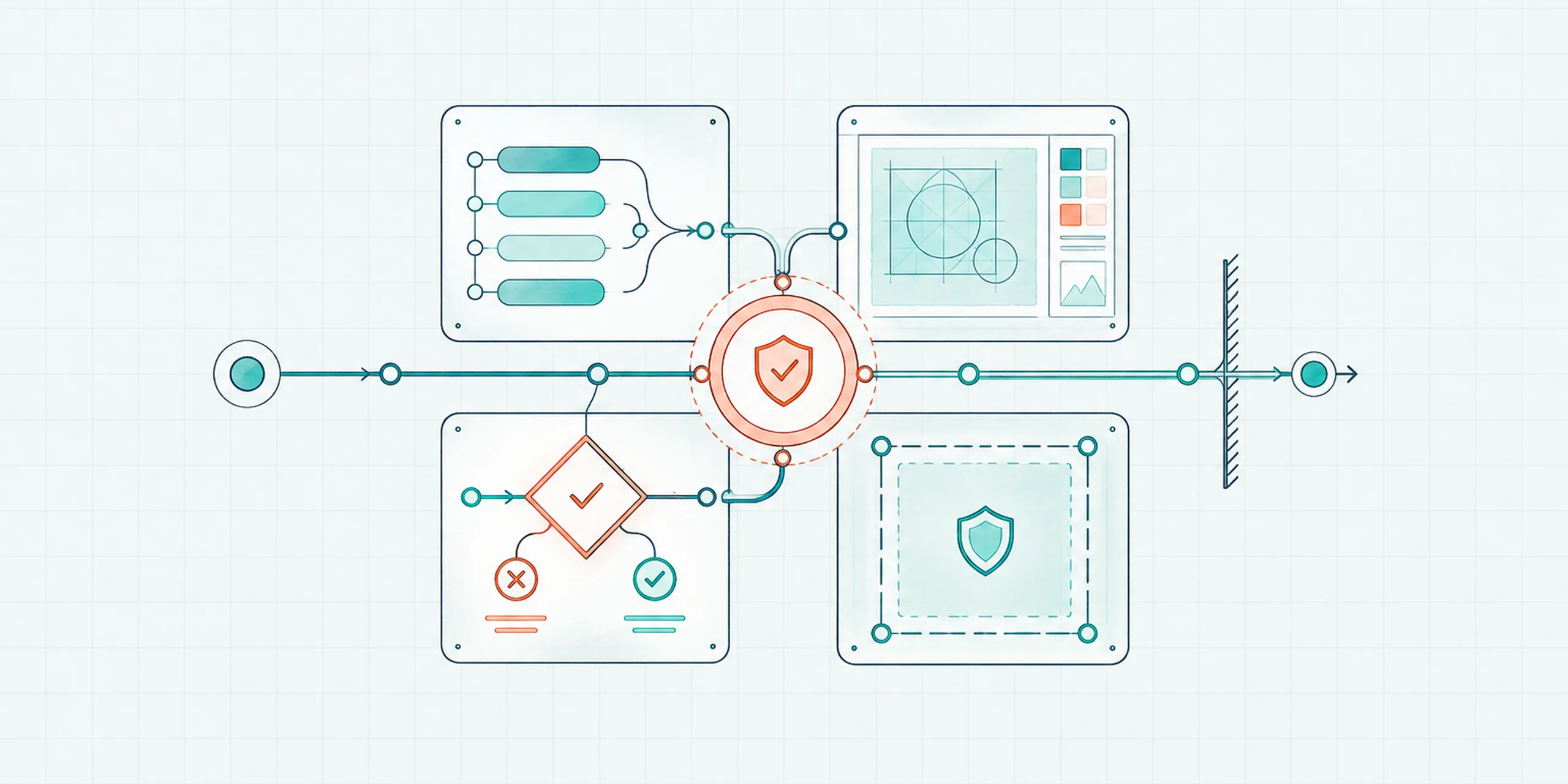
Octavus structures authority around four concrete action boundaries documented in the company Handbook:
- Allowed - The agent completes the action independently within written limits.
- Draft first - The agent prepares the work, but a person reviews and executes it.
- Approval required - The agent prepares the exact action, stops, and waits for a designated person to sign off before firing.
- Prohibited - The agent never performs the action under any circumstance.
| Category | What the agent does | Operational example |
|---|---|---|
| Allowed | Executes independently within written limits | Corrects data formatting in CRM custom fields without changing deal values |
| Draft first | Prepares complete work for human delivery | Drafts an outbound campaign email; the marketing manager reviews and sends it |
| Approval required | Prepares the action and waits for explicit sign-off | Flags an overdue supplier invoice and queues payment after the budget owner approves |
| Prohibited | Never attempts or initiates the action | Commits to customized legal contract terms or releases production secrets |
Notice what this structure accomplishes. You do not argue with a model about abstract ethical principles. You define explicit autonomous agent stopping points for operational actions.
The agent knows exactly how far it can travel on its own computer before it must pause and ask.
Concrete thresholds over general advice
Rules only work when they are specific.
Writing "be careful with discounts" in a prompt is useless. The model will interpret "careful" differently on every run depending on temperature, context length, and phrasing.
Instead, write autonomous agent approval rules as verifiable thresholds:
- Sales Operations: May update contact details, log meeting notes, and adjust deal stages up to Proposal Sent. Any change to contract value, discount percentage, or closed-lost status requires sales director approval.
- Customer Success: May grant subscription credits up to $50 to resolve documented service interruptions. Credits between $50 and $250 require team lead approval. Credits above $250 are prohibited.
- Marketing: May publish scheduled social reminders and event notices from pre-approved campaign assets. Must draft product announcements and pricing changes for editorial sign-off.
- Accounts Payable: May extract line items and match purchase orders against approved vendor records. May not modify vendor remittance bank details.
Separate the verbs. Editing a database row is different from deleting it. Writing a report is different from publishing it to a public URL. Comparing competitive quotes is different from issuing a binding purchase order.
When you break complex workflows into distinct verbs, you discover that 80% of the workflow can run in the Allowed category. Only the final 20% needs a human check. That ratio delivers massive operating leverage without taking reckless organizational risk.
What happens when the approver is offline
The most common failure in human-in-the-loop autonomous agents is the approver bottleneck.
An agent prepares an urgent customer response, hits an approval boundary, and sends a ping to a VP who is boarding a cross-country flight. The ticket sits. The customer fumes. The executive team concludes that autonomous agents are slow.
Your autonomous agent escalation rules must answer a basic question: what happens when nobody answers?
A resilient guardrail policy establishes an unavailable-approver fallback:
- Non-blocking work continues. While waiting for approval on a gated action, the agent continues safe preparation. It logs the audit history, pulls background documentation, drafts alternative scenarios, and prepares the next task in its schedule.
- Named backup routes. If the primary approver does not respond within a defined window (such as two hours for customer-facing issues), the agent routes the request to an explicit backup role, not a random team channel.
- Explicit risk reporting. The agent states what is blocked, who holds the approval, and what deadline is at risk.
- No silent overrides. An agent must never treat silence as permission. If approval is required to send funds or delete records, the action stays paused until a human clicks approve.
This pattern keeps the agent productive without breaking organizational boundaries. An agent that cannot get sign-off to push code can still write test suites, run regression checks, and document changes. It never sits completely idle.
Handbooks over prompts, service permissions over goodwill
Where you put your autonomous agent guardrails matters as much as what they say.
Many engineering teams try to inject business guardrails into system prompts. That approach fails at scale. System prompts suffer from prompt drift, context window exhaustion, and accidental overwrites during model upgrades.
Octavus takes a different architectural stance. Company policies live in a shared, versioned Handbook that every agent and teammate can read. As documented in our support guide on setting autonomy and approval rules, Handbook policies define organizational expectations, escalation paths, and spending thresholds in plain prose.
When an agent encounters a situation covered by a Handbook policy, it reads the rule, verifies the threshold, and pauses. Reason 7 on our homepage captures the operating principle: your rules, and every action on the record.
At the same time, never confuse a Handbook policy with a security perimeter.
A policy tells the agent where it ought to stop. A service-side permission guarantees it cannot go further.
If an agent should not delete customer databases, do not rely solely on a Handbook rule that says "do not drop tables." Grant the agent's database user read and write permissions, and revoke drop table permissions entirely. If an agent should not spend more than $500, set a hard card limit on its corporate card in addition to the Handbook sign-off rule.
Combine operational policies in the Handbook with least-privilege technical access in the underlying software. That combination gives you defense in depth.
A working guardrails checklist
Before you give an autonomous agent an operational role on your team, verify these six controls:
- Four action categories - Every recurring task is classified as Allowed, Draft first, Approval required, or Prohibited.
- Verifiable thresholds - Spending limits, credit caps, and record changes use exact numbers rather than qualitative guidance.
- Named approvers - Every approval requirement identifies an exact role and an established internal contact route.
- Unavailable-approver fallback - The agent continues safe non-blocking tasks while waiting and reports deadline risk.
- Service-side enforcement - Destructive actions and admin privileges are locked down at the software layer, rather than in prompts alone.
- Complete audit trail - Every action, screenshot, and tool invocation is recorded in the task thread for retrospective review.
Getting Started
Autonomy without autonomous agent guardrails is reckless. Boundaries without autonomy are pointless.
The teams getting real productivity from autonomous agents do not waste time debating whether AI can be trusted. They do what good managers have always done: they define the job, set clear stopping points, and inspect the work.
Hire a pre-built Octavus Agent. Walk through our guide on onboarding an agent, give it the same tools as the role, and configure its autonomy and approval rules in your Handbook.
Deploy autonomous agents with explicit guardrails, clear stopping points, and full visibility over every action.