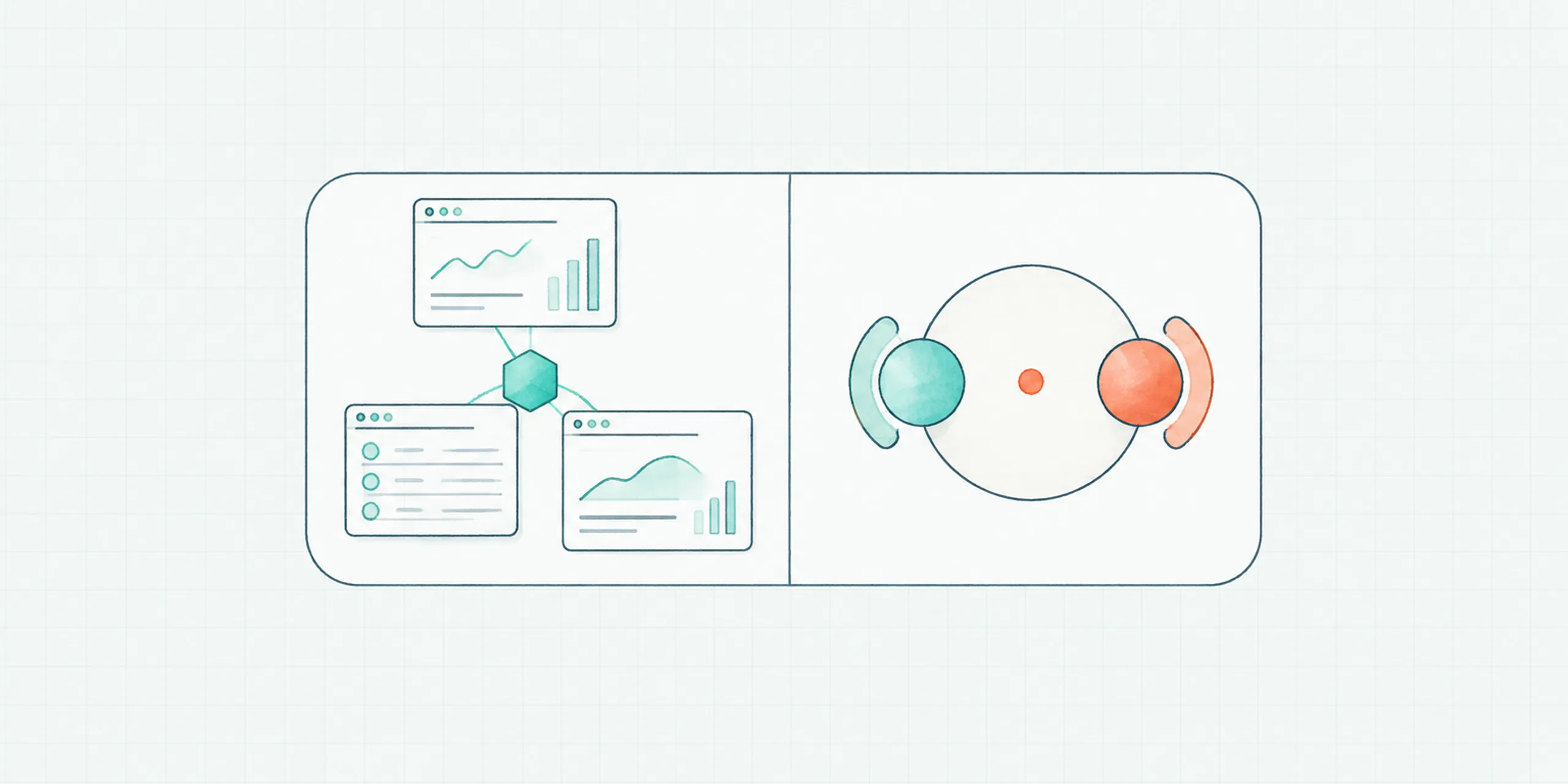
When the head of marketing operations left a software company we work with, the company had a gap nobody wanted to wait out. Someone had to run Salesforce and Marketo and keep the two in sync. Hiring for the seat would take months and cost a lot, especially in San Francisco. So the company onboarded an Octavus Agent and asked it to map every system and process in both tools. The mapping took a day. By day two the agent had process fixes in place and new campaigns running through Marketo and synced to Salesforce.
Look at what that work consisted of: mapping systems, fixing processes, building campaigns. All of it happens inside tools, and someone can check the result. It is the half of a job that needs no one across the table.
That half is the answer to the question executives ask first about autonomous agents for business: which work do we hand over first? The unit to hand over is a part of a job function. A list of tasks is the wrong unit.
Every job has a back half and a front half
The back half happens inside your systems. Building the list, reconciling the records, triaging the queue, drafting the report, keeping the knowledge base current. Rules govern it, and someone can check the result afterward.
The front half happens across a table from another person: the negotiation, the hard conversation, the judgment call a customer will remember.
Give the back half to an autonomous agent outright. It owns that work the way an employee in the seat would, starts from a schedule or an event, and reports after the fact. Keep the front half with your people. Last week's oversight post described the assistant arrangement, where a person watches every step. Here nobody watches. The person's hours go to the front half, which was always where they were worth the most.
Customers draw the same line
Gartner surveyed 3,566 customers in February and March 2026. Half said their interactions are easier when companies use generative AI, and 87% said it is essential to be able to reach a human agent when a company does. Customers accept automation for the work and want a person for the moment that matters. A function split in two respects both.
Large vendors describe the same split. At SAP Connect on October 6, Novartis's head of procurement said the aim of its Joule Sourcing Assistant pilot is for agents to handle "the manual heavy lifting, enabling sourcing professionals to focus on strategy, supplier engagement and value creation." That sentence has both halves in it. SAP's release adds that customers control the level of autonomy. It is a vendor announcement about a pilot, so read it as direction, not proof.
Four tests for the back half
Not every piece of the back half is ready on day one. Run each item through four questions:
- Can you name the finish line? "Prospect list of 25, emails verified" qualifies. "Improve the pipeline" does not.
- Does it live in the apps the role already uses? The agent works in the same tools, under its own login.
- Can the rules fit on a page? What it may do, what it drafts, what needs approval.
- Can someone check it afterward? The record shows what happened without anyone watching it happen.
Anything that fails a test waits. Anything that passes goes on the list. The onboarding post covers how to give the seat its context.
An illustrative map by function
Treat this as a starting sketch. Your lines depend on your roles.
| Function | Back half to hand over | Front half to keep |
|---|---|---|
| Sales development | Prospect research, lists, CRM upkeep, follow-up drafts | Discovery calls, pricing, negotiation |
| Recruiting | Sourcing, candidate pipeline, scheduling | Interviews, offers, closing a candidate |
| Customer support | Triage, routine tickets, knowledge base upkeep | Complaints, goodwill decisions, anyone who asks for a person |
| Marketing operations | Mapping systems, process fixes, campaign build and sync | Positioning, budget calls, agency relationships |
| Executive support | Calendar, inbox triage, follow-ups, briefings | Who gets your time, sensitive correspondence |
| Finance operations | Collections prioritization, billing checks, reconciliations | Disputes with a key customer, exceptions to policy |
Several rows match roles in the Octavus roster: business development, support engineer, executive assistant, recruiting sourcer. SAP's customer examples point at the same ground. Nestlé describes prioritizing collections work by risk and business context. PwC describes a billing assistant that flags issues early.
Write the line down
Deloitte's data suggests this is the step most companies are missing. In its survey of 3,235 leaders, only 21% said their organization has a mature governance model for agentic AI. Deloitte's first example of what is absent is "clear boundaries for agents that define which decisions they can make independently versus which require human approval."
A boundary has to be specific enough to act on. Octavus's support guidance on approval and escalation rules makes the point with two sentences. "Can manage email" leaves sending unclear. "May send routine scheduling confirmations to existing contacts, but must draft pricing replies for review" describes a decision the agent can use. The second sentence is the back-half and front-half line, drawn for one task.
The line also needs a handoff. When a case crosses into the front half, the agent passes it to a named person with the work already done. Gartner's advice on customer service says the same: give customers a visible path to a human, and pass along the information and context already collected. Our guardrails post lists the four levels of authority, and the delegation post covers who may hand the agent work.
A checklist for the first function
- Pick one function where the back half fills much of the week.
- List its recurring work. Mark each item back half or front half.
- Run the back-half items through the four tests. Drop the failures for now.
- Write the rules and the handoff: who receives a front-half case, and what the agent attaches.
- Hire the agent, give it the role context, and have it map the systems first, as the marketing operations team above did.
- After two weeks, read the record and move the line.
The first function teaches you where your lines are. The second goes faster, because the rules and the habit of splitting already exist.
What this looks like on Octavus
An Octavus Agent arrives as a role, with its own computer, email, phone number, and logins, working in the same apps as the seat. Your team writes its rules in the Handbook, and Threads keep the record of every step. The hire and onboard guide walks through the first hire, and the overview of autonomous AI agents defines the term.
Pick a role, give it the back half of the job, and keep your people on the front.