A successful AI agent pilot proves that a model can complete a task once. Production asks a harder question: can your organization delegate that task repeatedly, with the right access, evidence, and accountability?
That gap is where promising pilots stall. The demo works, but nobody owns the agent's decisions. Permissions are broader than the job. Approval rules live in someone's head. When a run goes wrong, the team cannot reconstruct what happened.
AI agent governance closes that gap. This playbook gives business, operations, security, and product leaders a practical way to move autonomous agents from controlled experiments into dependable work.
What AI agent governance means
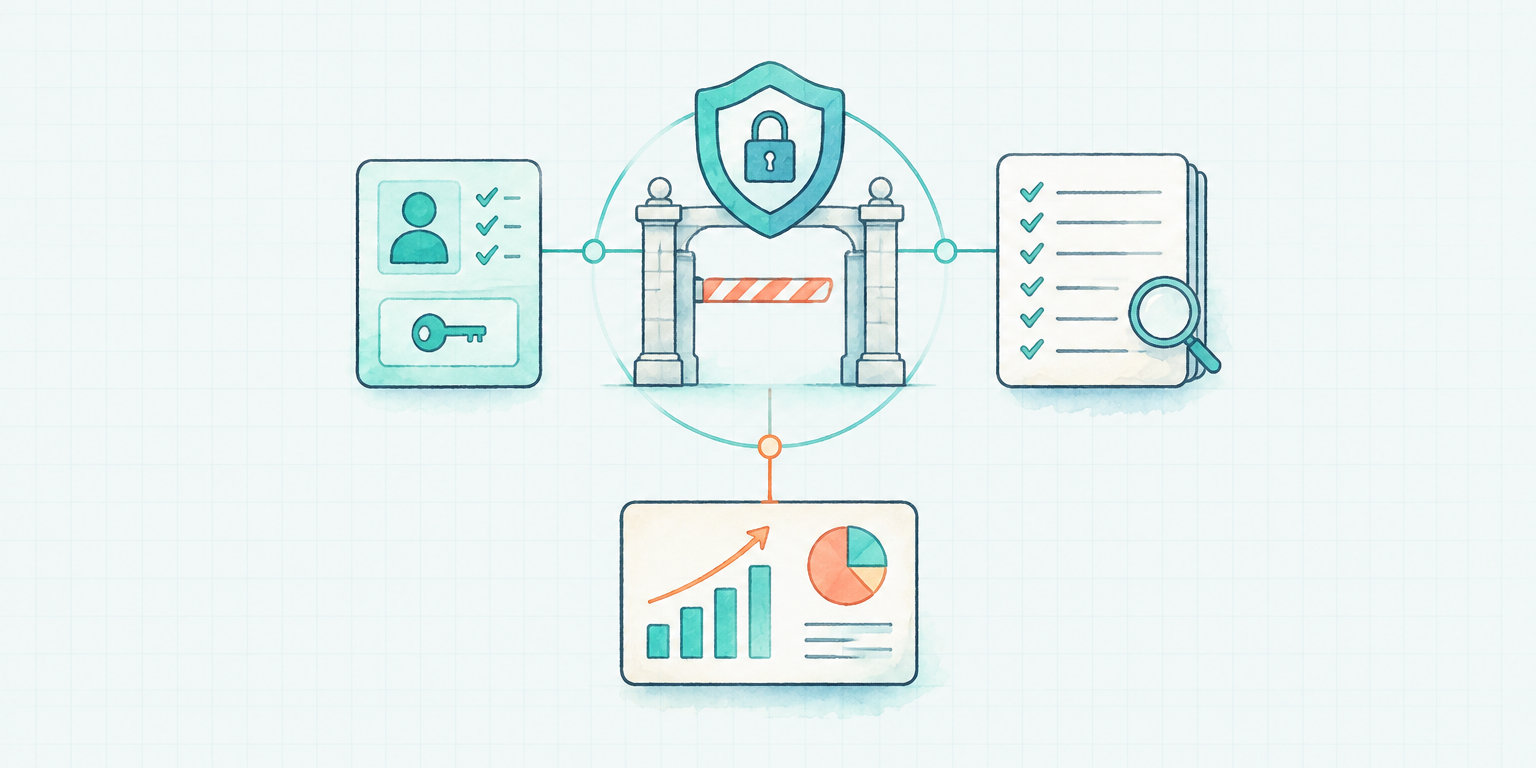
AI agent governance is the system of ownership, permissions, operating rules, monitoring, and review that controls how an agent works.
The unit being governed is larger than the model. A working agent combines:
- a defined job and expected output
- instructions and business context
- an identity and credentials
- tools, APIs, or computer access
- memory and retained state
- triggers that start work
- logs that show what happened
- escalation and recovery paths
A model can suggest an email. An agent can open the CRM, choose a contact, draft the message, and send it. Governance determines which of those steps it may take alone, which require approval, and how the organization reviews the result.
The need is now explicit in public standards work. In February 2026, NIST launched its AI Agent Standards Initiative around interoperable and secure adoption. NIST's related identity and authorization work focuses on how organizations identify agents, authorize their actions, audit what they do, and prevent prompt-injection attacks.
Why AI agent pilots fail on the way to production
Teams often treat the pilot as a model test. Production is an operating-system test for the organization around the model.
The job is too vague
"Help with customer success" sounds reasonable in a demo. It does not define what the agent owns, which systems it may change, or what a good week looks like.
A production job needs a clear input, output, boundary, and service level. For example: review new support tickets every 15 minutes, classify them, draft answers from approved documentation, and escalate billing or security questions without sending a reply.
Authority arrives before evidence
A prototype commonly uses an administrator's account because it is fast. That shortcut becomes dangerous when the agent begins running on schedules, reading untrusted content, or chaining several tools together.
The OWASP Top 10 for Agentic Applications 2026 covers risks such as goal hijacking, tool misuse, identity and privilege abuse, memory poisoning, and cascading failures. These are workflow risks. A capable model cannot compensate for an agent that has unnecessary authority.
Nobody owns the outcome
An agent can sit between product, IT, security, and the business team while belonging to none of them. Incidents then become group discussions instead of decisions.
Every production agent needs one business owner. That person approves the job, the autonomy level, the success measures, and material changes to access or scope. Technical and security partners still review controls, but one named owner remains accountable for the result.
The team cannot replay a run
A transcript alone is incomplete. It may omit the trigger, tool arguments, retrieved context, intermediate decisions, errors, and state changes that produced the final output.
Without a chronological trace, teams cannot explain a failure, distinguish a model problem from a tool problem, or prove that an approval happened. Improvement becomes guesswork.
The pilot has no expansion plan
Teams either keep the agent in permanent review mode or jump directly to broad autonomy. Both approaches waste the learning produced by the pilot.
A better rollout defines the next permission the agent can earn and the evidence required to earn it.
Use an autonomy ladder
Governance becomes easier when autonomy is a set of levels rather than a yes-or-no decision.
| Level | Agent behavior | Typical control |
|---|---|---|
| 1. Observe | Reads data and summarizes | Read-only access, sampled review |
| 2. Recommend | Suggests a decision or next action | Human makes the decision |
| 3. Draft | Prepares work inside a system | Human approves before external impact |
| 4. Act with gates | Completes routine steps, pauses at defined checkpoints | Approval for sensitive or irreversible actions |
| 5. Bounded autonomy | Completes a narrow workflow independently | Limits, traces, alerts, and rollback |
The right level depends on impact and reversibility. An agent may autonomously tag support tickets while requiring approval to issue a refund. It may update an internal research note but stop before publishing a public claim.
This is least agency in practice: give the agent enough freedom to complete the job, then add authority only when the business benefit and operating evidence justify it.
The AI agent governance playbook
1. Name the job and its owner
Write a one-paragraph job charter before selecting a model or integration.
The charter should answer:
- What event starts the work?
- What output must the agent produce?
- Which systems and data does it need?
- What is outside its scope?
- Who owns the business outcome?
- How quickly should the work finish?
Keep the job narrow enough that a reviewer can tell whether a run succeeded. If the charter contains several unrelated outputs, split it into separate workflows or agents.
2. Inventory actions, then tier the risk
List every action the agent may take, including the quiet ones: searching records, downloading files, updating memory, opening links, sending messages, changing permissions, running code, or calling another agent.
Assign each action a simple tier:
- Low: read-only, internal, and easy to verify
- Medium: changes internal state or communicates with a limited audience
- High: external, sensitive, financial, privileged, or difficult to reverse
Risk should follow the action, not the agent's brand or model. The same agent can have low-risk access to a knowledge base and high-risk access to a payment system.
3. Give the agent its own identity
Shared human credentials erase accountability. Use a distinct account, token, or service identity for the agent whenever the system supports it.
Grant only the permissions required by the job charter. Separate read and write access. Limit data scope, environment, tool set, and session duration where possible. Store secrets outside prompts and ordinary memory.
NIST's 2026 agent identity and authorization project emphasizes identification, authorization, auditing, and non-repudiation for agents. The practical implication is straightforward: your logs should show which agent acted, under which authority, and on whose behalf.
4. Treat instructions and memory as controlled inputs
Agent behavior changes when its instructions, references, tools, or retained memory change. Govern those inputs like operational configuration.
- Keep standing instructions in a versioned source of truth.
- Record who changed access, prompts, tools, and scheduled triggers.
- Separate durable policy from temporary task context.
- Review information before promoting it into long-term memory.
- Mark external documents, emails, and web pages as untrusted inputs.
Memory deserves special attention because a poisoned entry can influence future runs long after the original interaction. Define what the agent may remember, how long it persists, and how a human can inspect or remove it.
5. Put approval gates at the point of consequence
Requiring approval for every step creates a slow copilot. Requiring none turns ordinary mistakes into incidents.
Place gates before actions that are sensitive, expensive, external, or hard to reverse. An approval request should give the reviewer enough context to decide quickly:
- the proposed action and target
- the evidence the agent used
- the expected effect
- the relevant policy or threshold
- the rollback path, if one exists
- an expiration time for the approval
Approval rules should be deterministic when possible. "Refunds above $100 require support-lead approval" is governable. "Ask when the situation feels risky" is not.
6. Trace the complete run
Capture the trigger, context, model and configuration, tool calls, tool results, approvals, errors, final output, timing, and cost. Protect sensitive values, but preserve enough evidence to reconstruct the run.
A useful trace answers five questions:
- Why did the agent start?
- What information did it receive?
- What did it decide and do?
- What changed in an external system?
- How did the run end?
Octavus sessions retain conversation state, resources, and variables. Execution logs provide a chronological record of triggers, messages, tool calls, model responses, errors, and per-step telemetry. That record supports debugging and business review from the same run.
7. Measure outcomes and controls separately
A safe agent that creates no value should not stay in production. A productive agent that regularly crosses policy boundaries should not expand.
Track both sides of the scorecard.
Business measures may include completion rate, cycle time, cost per completed task, backlog reduction, acceptance rate, or revenue influenced.
Control measures may include approval rate, override rate, out-of-scope attempts, failed tool calls, policy violations, rollback frequency, and incidents by severity.
Compare the agent with the current process, not with a perfect theoretical worker. Include the time humans spend reviewing and correcting its work.
8. Roll out by evidence
Start with historical or synthetic cases. Move to read-only production data. Then let the agent draft, act with approval, and finally handle a bounded subset autonomously.
Set promotion criteria before each stage. A customer-support agent might need 95% correct routing across 500 sampled tickets, zero exposure of restricted data, and a declining human-edit rate before it can send answers for one low-risk category.
Also define the stop conditions: a spike in tool errors, an unexpected access attempt, a policy violation, or a metric dropping below threshold. The team should know how to pause triggers, revoke credentials, preserve logs, and return the workflow to humans.
A 30-day path from pilot to production
A governance program does not require a new committee for every workflow. It needs decisions made in the right order.
Week 1: Define
- Write the job charter and name the owner.
- List actions, systems, data, and failure modes.
- Choose the initial autonomy level.
- Define business and control measures.
Week 2: Constrain
- Create the agent's identity.
- Apply least-privilege access.
- Version instructions and approved references.
- Add approval gates and stop conditions.
Week 3: Observe
- Run historical, synthetic, and adversarial cases.
- Verify that traces contain the evidence reviewers need.
- Test failures in tools, credentials, context, and external systems.
- Rehearse pause, rollback, and escalation.
Week 4: Release
- Start with a narrow production cohort.
- Review early runs daily.
- Publish a short scorecard to the owner and operators.
- Expand one permission, use case, or volume band at a time.
AI agent governance checklist
Before production, confirm that:
- One person owns the business outcome.
- The agent has a written job, boundary, and expected output.
- Every tool and action has a risk tier.
- The agent uses its own identity with least-privilege access.
- Secrets are stored outside prompts and ordinary memory.
- Instructions, references, memory rules, and triggers are controlled.
- Sensitive or irreversible actions have explicit approval gates.
- Complete runs are traceable from trigger to external change.
- Business value and control health have separate measures.
- Promotion and stop criteria are written before launch.
- The team has tested pause, revocation, rollback, and escalation.
The NIST AI Risk Management Framework offers a useful umbrella for this work through four functions: Govern, Map, Measure, and Manage. The checklist above turns that lifecycle into agent-specific operating decisions.
How Octavus supports governed autonomy
Octavus Agents work through their own computers, tools, accounts, and memory. That makes the operating boundary visible: each agent has a role, an identity, explicit access, and a record of its work.
Teams can use focused triggers to start defined workflows instead of exposing one vague "do anything" entry point. Stateful sessions preserve the working context. Execution traces show what happened across model and tool steps. Skills extend capability as named, reviewable packages.
For a broader deployment guide, read AI Agent Best Practices. For the infrastructure behind dependable runs, see Building Production AI Agents. If you are still defining the category, start with Autonomous AI Agents.
Good governance makes autonomy easier to expand because the team can see what the agent is allowed to do, what it actually did, and whether the result earned more trust.
Getting Started
Explore pre-built Octavus Agents for roles that work in real business systems, or read the developer documentation to build governed agent workflows on the Octavus platform.
Start with a defined role, give it the right context and access, and watch the work happen live.